每个开发者都应该知道的8个OOP核心概念
面向对象编程就像搭积木,掌握了这些积木块,你就能搭建出数字摩天大楼。
面向对象编程(Object-Oriented Programming,简称 OOP)诞生于20世纪60年代,但在20世纪90年代随着 Java 和 C++ 的兴起真正进入主流。
为什么几十年过去了,OOP 依然是现代编程的基石?因为它让代码更易理解、更易维护、更易扩展。
今天,我们来系统掌握 OOP 的 8 个核心概念。
一、什么是 OOP?
核心思想:用”对象”来模拟现实世界
想象一下,你在描述一辆汽车:
-
传统方式(面向过程):定义
启动汽车()、加速()、刹车()等函数 -
OOP方式:创建一个
Car对象,它知道如何启动、加速、刹车
❌ 面向过程
car_color = “红色” car_speed = 0 def start_car(): global car_speed car_speed = 10 def accelerate(): global car_speed car_speed += 20
问题:数据和操作分离,容易出错
✅ 面向对象
class Car: def init(self, color): self.color = color self.speed = 0 def start(self): self.speed = 10 print(f”{self.color}汽车启动了”) def accelerate(self): self.speed += 20 print(f”加速到 {self.speed} km/h”) my_car = Car(“红色”) my_car.start() my_car.accelerate()
优势:数据和操作封装在一起
OOP 的价值:
-
🎯 组织性:像工具箱一样,每个工具都有固定位置
-
🔧 可维护性:修改一个类不影响其他代码
-
🔄 可重用性:一次编写,多次使用
-
📈 可扩展性:通过继承添加新功能
二、8种核心概念全景图
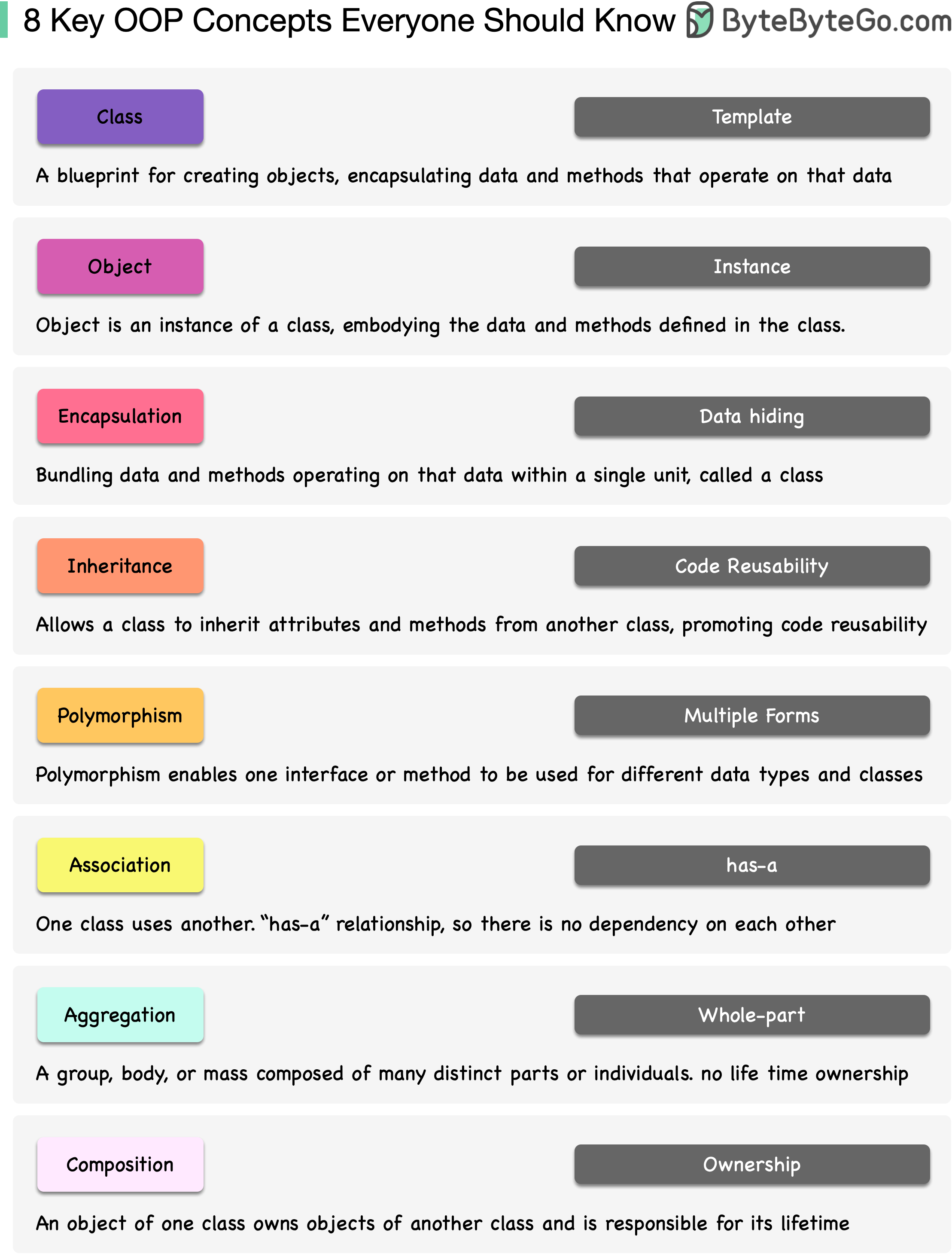
三、OOP 的四大支柱
1. 封装 (Encapsulation)
核心思想:隐藏内部细节,暴露必要的接口
现实类比:电视机
-
✅ 你知道:电源按钮、音量按钮、HDMI接口
-
❌ 你不知道:内部电路如何工作
-
好处:你不需要理解内部就能使用
代码示例:
// ❌ 没有封装 class BankAccount { public double balance; // 任何人都能直接修改! public static void main(String[] args) { BankAccount account = new BankAccount(); account.balance = 1000000; // 😱 随便改余额! } } // ✅ 使用封装 class BankAccount { private double balance; // 私有变量,外部无法访问 public void deposit(double amount) { if (amount <= 0) { throw new IllegalArgumentException(“金额必须大于0”); } balance += amount; } public void withdraw(double amount) { if (amount > balance) { throw new IllegalArgumentException(“余额不足”); } balance -= amount; } public double getBalance() { return balance; // 只读,不能直接修改 } }
封装的三层访问控制:
| 修饰符 | 同一类 | 同一包 | 子类 | 所有类 |
|---|---|---|---|---|
| private | ✅ | ❌ | ❌ | ❌ |
| default | ✅ | ✅ | ❌ | ❌ |
| protected | ✅ | ✅ | ✅ | ❌ |
| public | ✅ | ✅ | ✅ | ✅ |
最佳实践:
-
✅ 变量设为
private -
✅ 提供公用的 getter/setter
-
✅ 在方法中添加业务规则验证
2. 继承 (Inheritance)
核心思想:基于现有类创建新类,复用代码
现实类比:
动物 (基类) ├─ 狗 (子类) ├─ 猫 (子类) └─ 鸟 (子类) 子类继承父类的特征和行为
代码示例:
基类(父类)
class Animal: def init(self, name, age): self.name = name self.age = age def eat(self): print(f”{self.name}在吃东西”) def sleep(self): print(f”{self.name}在睡觉”)
子类继承父类
class Dog(Animal): def bark(self): print(f”{self.name}在汪汪叫”) class Cat(Animal): def meow(self): print(f”{self.name}在喵喵叫”)
使用
dog = Dog(“旺财”, 3) dog.eat() # 继承自父类的方法 dog.bark() # 子类特有的方法 cat = Cat(“咪咪”, 2) cat.eat() # 继承自父类的方法 cat.meow() # 子类特有的方法
方法重写 (Override):
class Animal: def make_sound(self): print(“动物发出声音”) class Dog(Animal): def make_sound(self): print(“汪汪汪”) # 重写父类方法 class Cat(Animal): def make_sound(self): print(“喵喵喵”) # 重写父类方法
多态
animals = [Dog(“旺财”), Cat(“咪咪”)] for animal in animals: animal.make_sound() # 根据实际类型调用不同方法
继承的陷阱:
-
⚠️ 过度继承:继承层次过深(超过3层)难以理解
-
⚠️ 脆弱基类:修改父类可能破坏所有子类
-
⚠️ 组合优于继承:优先使用组合(has-a)而非继承(is-a)
3. 多态 (Polymorphism)
核心思想:同一接口,不同实现
现实类比:
“开车”这个动作:
- 开自动挡汽车:踩油门就走
- 开手动挡汽车:还要控制离合器
- 开电动车:没有发动机声音 同样是”开车”,但不同车型有不同的实现
代码示例:
// 定义接口 interface Payment { void pay(double amount); } // 不同的实现 class CreditCardPayment implements Payment { public void pay(double amount) { System.out.println(“使用信用卡支付 $” + amount); } } class PayPalPayment implements Payment { public void pay(double amount) { System.out.println(“使用PayPal支付 $” + amount); } } class WeChatPayment implements Payment { public void pay(double amount) { System.out.println(“使用微信支付 ¥” + amount); } } // 多态的使用 public class PaymentProcessor { public void processPayment(Payment payment, double amount) { payment.pay(amount); // 根据实际类型调用不同实现 } public static void main(String[] args) { PaymentProcessor processor = new PaymentProcessor(); // 运行时决定使用哪种支付方式 Payment payment = getPaymentMethod(); processor.processPayment(payment, 100.0); } }
多态的两种形式:
| 类型 | 实现方式 | 示例 |
|---|---|---|
| 编译时多态 | 方法重载 | print(int) vs print(String) |
| 运行时多态 | 方法重写 | Animal.makeSound() |
多态的好处:
-
✅ 灵活性:可以随时添加新实现
-
✅ 可扩展性:不需要修改现有代码
-
✅ 解耦:调用者不需要知道具体实现
4. 抽象 (Abstraction)
核心思想:隐藏复杂细节,展示必要功能
现实类比:
驾驶员不需要知道:
- 发动机如何工作
- 变速箱如何换挡
- 刹车系统如何运作
驾驶员只需要知道:
- 方向盘控制方向
- 油门加速
- 刹车减速
代码示例:
from abc import ABC, abstractmethod
抽象类(不能直接实例化)
class Shape(ABC): @abstractmethod def area(self): pass # 子类必须实现
@abstractmethod
def perimeter(self):
    pass  # 子类必须实现
具体类
class Circle(Shape): def init(self, radius): self.radius = radius
def area(self):
    return 3.14 * self.radius ** 2

def perimeter(self):
    return 2 * 3.14 * self.radius
class Rectangle(Shape): def init(self, width, height): self.width = width self.height = height
def area(self):
    return self.width * self.height

def perimeter(self):
    return 2 * (self.width + self.height)
使用
shapes = [Circle(5), Rectangle(4, 6)] for shape in shapes: print(f”面积: {shape.area()}”) print(f”周长: {shape.perimeter()}”)
抽象 vs 接口:
| 维度 | 抽象类 | 接口 |
|---|---|---|
| 实现 | 可以有部分实现 | 只有方法签名 |
| 变量 | 可以有实例变量 | 只能有常量 |
| 继承 | 单继承 | 多实现 |
| 用途 | 复用代码 | 定义契约 |
何时使用抽象?
-
✅ 定义通用接口(如
Shape、Animal) -
✅ 隐藏复杂实现细节
-
✅ 强制子类实现特定方法
四、OOP 的进阶概念
5. 类与对象 (Class vs Object)
核心区别:类是模板,对象是实例
现实类比:
类 = 饼干模具 对象 = 用模具做出的饼干
一个模具可以做出很多饼干 但每个饼干都是独立的个体
代码示例:
// 类(模板) class User { constructor(name, email) { this.name = name; this.email = email; }
sayHello() {
    console.log(`你好,我是${this.name}`);
}
}
// 对象(实例) const user1 = new User(“张三”, “zhangsan@example.com”); const user2 = new User(“李四”, “lisi@example.com”);
user1.sayHello(); // 你好,我是张三 user2.sayHello(); // 你好,我是李四
console.log(user1 === user2); // false(两个不同的对象)
关键要点:
-
类定义了对象的属性和方法
-
对象是类的具体实例
-
一个类可以创建多个对象
-
每个对象有独立的状态
6. 方法 (Methods)
核心思想:对象的行为
方法 vs 函数:
| 维度 | 方法 | 函数 |
|---|---|---|
| 归属 | 属于类/对象 | 独立存在 |
| 访问 | 可以访问私有成员 | 只能访问参数 |
| 调用 | object.method() | function() |
方法的类型:
class Calculator: # 实例方法(最常用) def add(self, a, b): return a + b
# 类方法(操作类本身)
@classmethod
def get_info(cls):
    return f"This is a {cls.__name__}"

# 静态方法(与类无关的工具函数)
@staticmethod
def multiply(a, b):
    return a * b

# 魔术方法(重载运算符)
def __call__(self, x):
    return x * 2
calc = Calculator() print(calc.add(1, 2)) # 实例方法 print(Calculator.get_info()) # 类方法 print(Calculator.multiply(3, 4)) # 静态方法 print(calc(5)) # 魔术方法,输出10
最佳实践:
-
✅ 方法名应该是动词(
calculateTotal()、sendEmail()) -
✅ 一个方法只做一件事
-
✅ 方法参数不超过5个
7. 消息传递 (Message Passing)
核心思想:对象通过调用方法来”通信”
现实类比:
你(对象A)想点外卖 ↓ 发送消息:call(外卖小哥) ↓ 外卖小哥(对象B)收到消息 ↓ 执行动作:deliverFood()
代码示例:
class OrderProcessor def process_order(order) # 发送消息给库存系统 inventory = InventorySystem.new inventory.check_stock(order.items)
# 发送消息给支付系统
payment = PaymentSystem.new
payment.charge(order.customer, order.total)

# 发送消息给物流系统
shipping = ShippingSystem.new
shipping.schedule_delivery(order.address)
end end
每个系统是独立的对象
它们通过”消息传递”来协作
不需要知道其他对象的内部实现
消息传递的好处:
-
✅ 解耦:对象之间低耦合
-
✅ 灵活性:可以替换消息接收者
-
✅ 并发:消息可以异步处理
8. 组合 (Composition)
核心思想:通过组合其他对象来构建复杂对象
组合 vs 继承:
继承(is-a 关系): 狗 is-an 动物 ✅ 猫 is-an 动物 ✅ 汽车 is-an 引擎 ❌ (不对!)
组合(has-a 关系): 汽车 has-an 引擎 ✅ 汽车 has-four 轮胎 ✅ 计算机 has-a CPU ✅
代码示例:
❌ 滥用继承
class Car: def start(self): print(“汽车启动”)
class Engine: def ignite(self): print(“引擎点火”)
汽车继承引擎?不对!
class SportsCar(Car, Engine): # 多重继承,复杂 pass
✅ 使用组合
class Engine: def ignite(self): print(“引擎点火”)
class Wheel: def rotate(self): print(“轮胎转动”)
class Car: def init(self): self.engine = Engine() # 组合:汽车”有”一个引擎 self.wheels = [Wheel() for _ in range(4)] # 组合:汽车”有”四个轮胎
def start(self):
    self.engine.ignite()
    for wheel in self.wheels:
        wheel.rotate()
print("汽车启动")组合的优势:
-
✅ 灵活性:可以在运行时更换组件
-
✅ 避免继承爆炸:不需要多层继承
-
✅ 更符合现实:大部分关系是”has-a”而非”is-a”
最佳实践:
优先使用组合,而非继承(Favor Composition over Inheritance)
五、OOP 设计原则(SOLID)
在掌握了8个核心概念后,还需要遵循5大设计原则:
| 原则 | 全称 | 含义 |
|---|---|---|
| S | Single Responsibility | 一个类只做一件事 |
| O | Open/Closed | 对扩展开放,对修改关闭 |
| L | Liskov Substitution | 子类可以替换父类 |
| I | Interface Segregation | 接口要小而专 |
| D | Dependency Inversion | 依赖抽象,不依赖具体 |
代码示例(违反SOLID vs 遵循SOLID):
❌ 违反单一职责原则
class User: def save_to_database(self): pass
def send_email(self):
    pass

def generate_report(self):
    pass
一个类做了太多事情!
✅ 遵循单一职责原则
class User: def init(self, name, email): self.name = name self.email = email
class UserRepository: def save(self, user): pass
class EmailService: def send(self, to, subject, body): pass
class ReportGenerator: def generate(self, user): pass
六、实战案例:电商系统
让我们用一个完整的电商系统来综合运用8个概念:
1. 抽象:定义支付接口
from abc import ABC, abstractmethod
class Payment(ABC): @abstractmethod def pay(self, amount): pass
2. 继承:具体支付方式
class CreditCardPayment(Payment): def pay(self, amount): print(f”信用卡支付 ¥{amount}”)
class WeChatPayment(Payment): def pay(self, amount): print(f”微信支付 ¥{amount}”)
3. 封装:订单类
class Order: def init(self, items): self.__items = items # 私有变量 self.__status = “pending”
def add_item(self, item):
    self.__items.append(item)

def get_total(self):
    return sum(item['price'] for item in self.__items)

def process_payment(self, payment_method):
    # 4\. 多态:运行时决定支付方式
    payment_method.pay(self.get_total())
    self.__status = "paid"

def __str__(self):
    return f"订单状态: {self.__status}, 总额: ¥{self.get_total()}"
5. 组合:购物车
class ShoppingCart: def init(self): self.items = []
def add(self, product, quantity):
    self.items.append({
        'product': product,
        'quantity': quantity,
        'price': product.price * quantity
    })

def checkout(self, payment_method):
    order = Order(self.items)
    order.process_payment(payment_method)
    return order
6. 类与对象
class Product: def init(self, name, price): self.name = name self.price = price
7. 方法
class Customer: def init(self, name): self.name = name self.cart = ShoppingCart()
def add_to_cart(self, product, quantity):
    self.cart.add(product, quantity)

def checkout(self, payment_method):
    return self.cart.checkout(payment_method)
8. 消息传递
class NotificationService: def send_confirmation(self, customer, order): print(f”发送通知给 {customer.name}: {order}”)
使用
product = Product(“iPhone”, 5999) customer = Customer(“张三”) customer.add_to_cart(product, 1)
payment = WeChatPayment() order = customer.checkout(payment)
notification = NotificationService() notification.send_confirmation(customer, order)
输出:
微信支付 ¥5999 发送通知给 张三: 订单状态: paid, 总额: ¥5999
七、OOP 的陷阱与最佳实践
⚠️ 常见陷阱
| 陷阱 | 表现 | 解决方案 |
|---|---|---|
| 上帝类 | 一个类做了太多事 | 拆分成多个小类 |
| 贫血模型 | 类只有数据没有行为 | 将业务逻辑移入类内 |
| 过度继承 | 继承层次过深 | 使用组合替代 |
| 循环依赖 | A依赖B,B依赖A | 引入中间层 |
✅ 最佳实践
-
类名应该是名词:
User、Order、Payment -
方法名应该是动词:
calculateTotal()、sendEmail() -
一个类只做一件事:单一职责原则
-
优先使用组合:而不是继承
-
保持类的简单:不超过200行代码
八、OOP 在现代编程中的演变
传统 OOP(Java、C++)
类定义 → 实例化对象 → 调用方法
函数式编程 + OOP(现代趋势)
// JavaScript: 函数式 + 面向对象 class UserService { async getUsers() { const response = await fetch(‘/api/users’); return response.json(); } }
// 或使用函数式写法 const getUsers = async () => { const response = await fetch(‘/api/users’); return response.json(); };
OOP 的未来
-
✅ 数据导向设计(Data-Oriented Design)
-
✅ 组件化架构(React、Vue)
-
✅ Actor模型(并发编程)
九、总结
OOP 的8个核心概念:
| 概念 | 作用 | 关键词 |
|---|---|---|
| 类与对象 | 模板 vs 实例 | 模板化 |
| 封装 | 隐藏细节 | 安全性 |
| 继承 | 复用代码 | 重用性 |
| 多态 | 同一接口,不同实现 | 灵活性 |
| 抽象 | 简化复杂度 | 易用性 |
| 方法 | 对象的行为 | 操作 |
| 消息传递 | 对象间通信 | 解耦 |
| 组合 | 构建复杂对象 | 模块化 |
记住:OOP 不是目的,而是手段。
真正的目标是:
-
📦 组织代码:让代码结构清晰
-
🔧 易于维护:修改一处不影响全局
-
🚀 便于扩展:添加新功能不破坏旧代码
最后建议:
不要害怕OOP,把它想象成创建数字乐高积木。看书、看教程,然后多写代码——没有比练习更好的学习方法了!
掌握这些概念,你就能从写简单的脚本,进阶到开发复杂的软件系统!
关注「善忘技术夹」全媒体矩阵
扫描上方宣传海报二维码,第一时间获取最新技术文章、开源项目与免安装小程序体验。